The first song you finish is the moment the piano stops being furniture and starts being yours. Let us get you there.
Pick a tune you can already hum
If the tune is already in your head, your ears do half the work. You will hear a wrong note straight away and know how the rhythm should go before you read it. That is why nursery songs and famous themes make such good first songs, at any age.
Three great first songs
Mary Had a Little Lamb (Easy) is the gentlest start: the right hand uses four notes, C4, D4, E4 and G4, and the whole song is eight bars long.
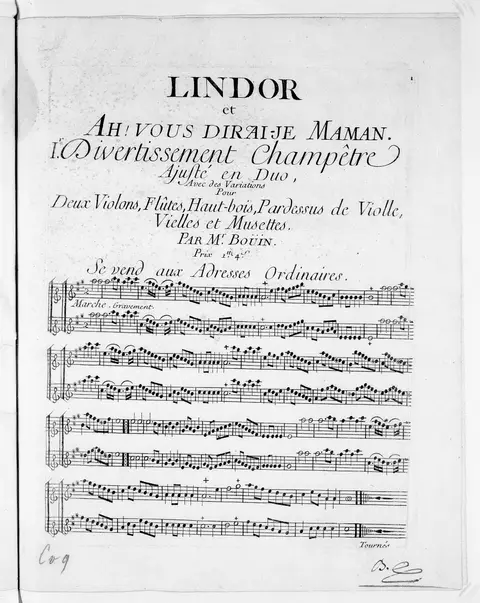
Twinkle, Twinkle, Little Star (Easy) uses six notes, from C4 up to A4, all white keys. The tune is older than most people think: it was first printed in France in 1761, without words, and its composer is unknown. Mozart later wrote twelve piano variations on it, published in 1785, and the English words come from a poem by Jane Taylor published in 1806.
Open the full pieceThe opening of Twinkle Twinkle Little Star: C, C, G, G, A, A, G. Press Play to hear it.A French print of 1761 with the tune, titled Ah! vous dirai-je maman, decades before it became Twinkle Twinkle. Lindor et Ah! vous dirai-je maman, title page. François Bouïn, 1761, Bibliothèque nationale de France. Wikimedia Commons, Public domain.
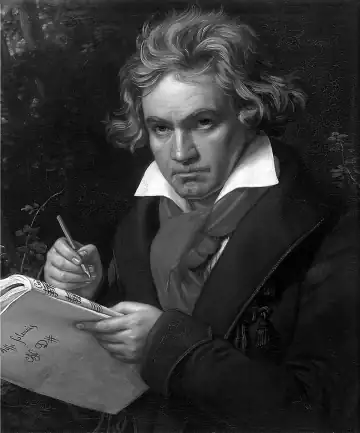
Ode to Joy (Easy) almost fits under five fingers, F4 to C5, with one black key, B♭, and a single reach down to C4. It is the big tune from the finale of Beethoven's Ninth Symphony, first performed in Vienna on 7 May 1824, where it sets part of Friedrich Schiller's poem An die Freude (To Joy).
Beethoven, who set Schiller’s words to the Ode to Joy tune in his Ninth Symphony. Ludwig van Beethoven with the score of the Missa solemnis. Joseph Karl Stieler, 1820. Wikimedia Commons, Public domain.The keys each song’s right hand plays, read from this site’s easy editions. Each fits under one hand.Two of these first songs are over 200 years old.
Learn it in five moves
Find middle C (C4): the white key just left of the group of two black keys nearest the middle of the piano.
Put your right thumb on the first note the song needs and rest one finger on each white key above it.
Play the right hand alone, saying the note names out loud. Set Hands in Options to Right and the page plays and shows just that hand.
Play the left hand alone. In these easy editions it plays slow, long notes.
Put the hands together with the Speed control turned down, then turn Listen on and try to clear every note.
Fingers are numbered from the thumb, 1, to the little finger, 5, on both hands. These are the five-finger C positions.Open the full pieceThe first four bars of Ode to Joy. The right hand starts on A4 and moves only a step at a time, with one black key, B♭.
Every piece page has the score, playback with the notes lit up, and a printable PDF. The three songs above also have a how-to-play guide below the score, with the tricky bars picked out.
Then level up
Once one song feels easy, take the next. The first level has dozens of short tunes, and after that come easy versions of famous pieces such as Für Elise (Easy) and Canon in D (Easy). If the notes on the page still feel like a puzzle, start with how to read piano notes.