The short answer: 88
Those 88 keys span a little over seven octaves, from a low A that vibrates 27.5 times a second (27.5 Hz) to a high C at 4,186 Hz.
How the 88 add up
Each key has a letter and an octave number, and the number goes up by one at every C, so middle C is C4. The piano starts on A, not C, so octave 0 has only three keys: A0, A♯0 and B0. Octaves 1 to 7 are complete, with 12 keys each, and octave 8 is a single key, C8. Three, plus seven twelves, plus one, makes 88.
To find any of them fast, learn the black-key map, or print the free piano keyboard chart with every key labelled.
Pianos did not always have 88
Bartolomeo Cristofori invented the piano in Florence around 1700. A Medici inventory of that year lists an instrument of his with a range of four octaves. The oldest surviving piano, which he made in 1720 and which is now in the Metropolitan Museum of Art, has 54 keys.
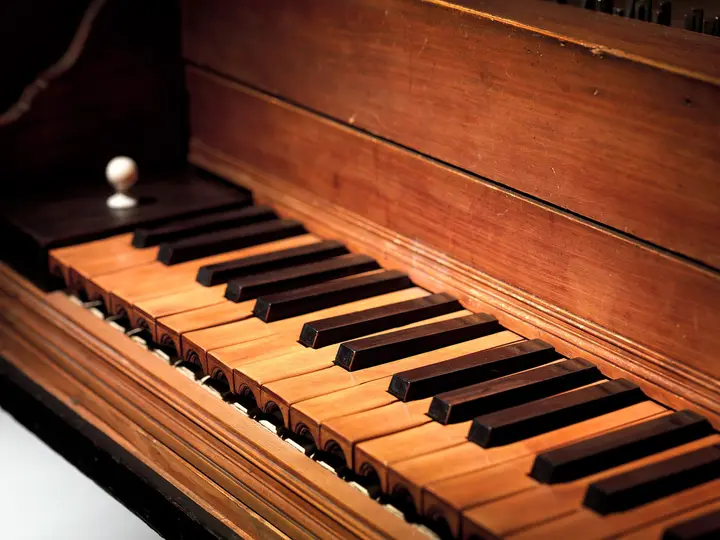
Pianos kept growing. Five octaves, 61 keys, was typical of the pianos Mozart and Haydn knew in the late 1700s, and by the middle of the 1800s many had seven octaves, 85 keys. Steinway’s Style 2 grand of 1868 was the company’s first model with 88 keys, and by the 1890s the 88-key keyboard had become the standard.
Why stop at 88?
Because more keys would not sound like more music. Yamaha explains that the highest pitches the brain can tell apart are at most around 4,000 Hz, close to the top C. Extra keys at the bottom would add little more than a rumble, and extra keys at the top an unpleasant noise. At the low end, 27.5 Hz is already where our hearing has dropped off a long way.
Keyboards with fewer keys
Acoustic pianos and digital pianos have 88 keys, and a digital piano’s are weighted to feel like a piano’s. Portable keyboards often have 61 or 76 keys, and small MIDI controllers, which play sounds from a computer, come with 25, 49 or 61.
For a beginner, the first pieces use only a small part of any of these. The right hand of Mary Had a Little Lamb (Easy) plays just four keys: C4, D4, E4 and G4.
Explore all 88
- Play every C from the bottom to the top. There are eight, C1 to C8.
- Find the lowest key, A0, and the highest, C8, and play them one after the other.
- Find middle C: the fourth C from the left.
- Open Mary Had a Little Lamb (Easy) and play its first notes from middle C.
From here, how to read piano notes takes you from the keys to the page.