

Key facts
- Level
- Level 4 · Intermediate. Estimated from the notes (0 of 8 on our difficulty score)
- Time signature
- 2/4
- Key signature
- No sharps or flats
- Length
- 17 bars, 2 pages
- Playing time
- 0:27
- Notes
- 110
- Range
- G2 to E5
Source and licence
Licence of the source: Public domain melody.
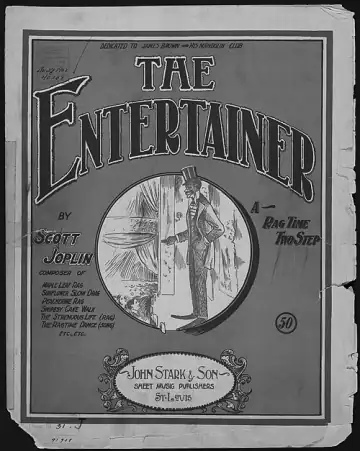
Source: Site-owned easy edition. Melody: The Entertainer (first strain, high phrases an octave lower), Scott Joplin (1902), public domain, checked against The Mutopia Project: The Entertainer. Left hand written for this site.
Source: The Mutopia Project: The Entertainer.
Playback sounds: Salamander Grand Piano by Alexander Holm (CC BY 3.0); Upright Piano KW by Gonzalo and Roberto of FreePats (CC0 1.0); Fluid R3 GM by Frank Wen and contributors (CC BY 3.0). Full sound credits.
How to play The Entertainer (Easy)
Ragtime in easy mode: the right hand gets the bouncy tune and the left hand keeps a steady two-step. The trick is the off-beat swing, and you can master it.
Where your hands go
Right hand: the pickup is D4, D♯4, then E4. Try fingers 2 and 3 for D4 and D♯4, then your thumb on E4 so your little finger can reach C5.
Left hand: mostly two notes a bar, C3 then G3, one per beat. Little finger on C3, thumb on G3.
The piece is in 2/4, two beats a bar, and nearly all the right-hand notes are sixteenths, four to a beat.
The tricky bars
Your practice plan
- Clap the right-hand rhythm of bars 1 and 2 while saying "1 e and a 2 e and a". This is the whole secret of ragtime.
- Right hand alone, bars 0 to 4, at half speed with the Speed control.
- Left hand alone: a steady march of C3, G3. Keep it rock solid; it is the floor the tune dances on.
- Hands together, two bars at a time, still at half speed.
- Bring the speed up a step at a time, then play it all with Listen on.
Watch out for
- Playing the tune square, with every note on the beat. The tied notes and off-beat starts are what make it swing.
- Restriking tied notes, especially the C5 from bar 1 to bar 2 and the E5 in bars 3, 11, 13, 14 and 15.
- Forgetting the D♯4 in the pickups to bars 1, 5 and 9.
- Letting the left hand speed up with the right. Ragtime should feel relaxed, not rushed.
Power-up: press Loop, tap the first and last of the tricky bars, and they repeat until they feel easy. Hands in Options lets you practise one hand at a time. New to the notation? Start with how to read keyboard staff, then how to practise piano.
0:00 / 0:27