Prelude in C major, BWV 846 (Well-Tempered Clavier I) sheet music

Johann Sebastian Bach (1685–1750), Level 7 · Advanced, 2:20

Download PDF
What changed in this conversion
  • Some held notes in bars 1–34 are shown shorter because that hand plays more than one rhythm at once. No notes were removed.
Prelude in C major, BWV 846 (Well-Tempered Clavier I), keyboard staff, page 1 of 4Prelude in C major, BWV 846 (Well-Tempered Clavier I)Johann Sebastian Bach (1685–1750). Regular keyboard staff. Print at 100%, not fit-to-page.CCDDEFFGGAABBold red line: C4 · Solid line: other Cs, D F G A · Dotted grey line: E | F and B | CC3C5441GCEGCEGCEGCEADFADFADFADFCEECEECDDCDDC3C53GDFGDFGDFGDFGCEGCEGCEGCEBDDBDDCEECEEC3C55AEAAEAAEAAEAF♯ADF♯ADF♯ADF♯ADCEECEECDDCDDC3C57GDGGDGGDGGDGEGCEGCEGCEGCBDDBDDBCCBCCC3C59EGCEGCEGCEGCDF♯CDF♯CDF♯CDF♯CACCACCDAADAASource: "Prelude in C major, BWV 846 (Well-Tempered Clavier I)", typeset by Tobias Erbsland, The Mutopia Project, https://www.mutopiaproject.org/cgibin/piece-info.cgi?id=5.Prelude in C major, BWV 846 (Well-Tempered Clavier I) · Page 1 of 4
Prelude in C major, BWV 846 (Well-Tempered Clavier I), keyboard staff, page 2 of 4C3C511DGBDGBDGBDGBEGC♯EGC♯EGC♯EGC♯GBBGBBGB♭B♭GB♭B♭C3C513DADDADDADDADDFBDFBDFBDFBFAAFAAFG♯G♯FG♯G♯C3C515CGCCGCCGCCGCACFACFACFACFEGGEGGEFFEFFC317ACFACFACFACFGBFGBFGBFGBFDFFDFFGDDGDDC319GCEGCEGCEGCEB♭CEB♭CEB♭CEB♭CECEECEECGGCGGC321ACEACEACEACEACE♭ACE♭ACE♭ACE♭FFFFFFF♯CCF♯CCSource: "Prelude in C major, BWV 846 (Well-Tempered Clavier I)", typeset by Tobias Erbsland, The Mutopia Project, https://www.mutopiaproject.org/cgibin/piece-info.cgi?id=5.Prelude in C major, BWV 846 (Well-Tempered Clavier I) · Page 2 of 4
Prelude in C major, BWV 846 (Well-Tempered Clavier I), keyboard staff, page 3 of 4C323BCDBCDBCDBCDGBDGBDGBDGBDG♯FFG♯FFGFFGFFC325GCEGCEGCEGCEGCFGCFGCFGCFGEEGEEGDDGDDC327GBFGBFGBFGBFACF♯ACF♯ACF♯ACF♯GDDGDDGE♭E♭GE♭E♭C329GCGGCGGCGGCGGCFGCFGCFGCFGEEGEEGDDGDDC331GBFGBFGBFGBFGB♭EGB♭EGB♭EGB♭EGDDGDDCCCCCCSource: "Prelude in C major, BWV 846 (Well-Tempered Clavier I)", typeset by Tobias Erbsland, The Mutopia Project, https://www.mutopiaproject.org/cgibin/piece-info.cgi?id=5.Prelude in C major, BWV 846 (Well-Tempered Clavier I) · Page 3 of 4
Prelude in C major, BWV 846 (Well-Tempered Clavier I), keyboard staff, page 4 of 4C3C533FACFCACAFAFDFDGBDFDBDBGBDFEDCCCCCBBBC3C535EGCCCSource: "Prelude in C major, BWV 846 (Well-Tempered Clavier I)", typeset by Tobias Erbsland, The Mutopia Project, https://www.mutopiaproject.org/cgibin/piece-info.cgi?id=5.Prelude in C major, BWV 846 (Well-Tempered Clavier I) · Page 4 of 4
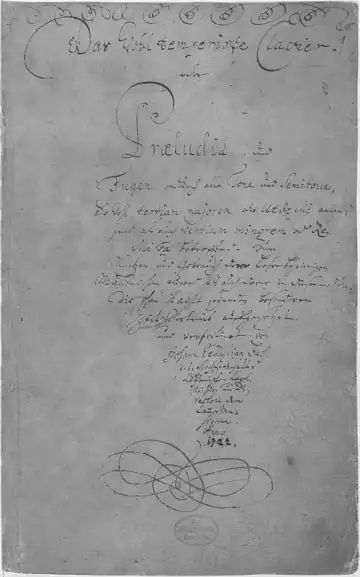
Bach's handwritten title page for the Well-Tempered Clavier
Title page of The Well-Tempered Clavier, in Bach's hand. Johann Sebastian Bach, 1722. Wikimedia Commons, Public domain.

Key facts

Level
Level 7 · Advanced. Estimated from the notes (1 of 8 on our difficulty score)
Time signature
4/4
Length
35 bars, 4 pages
Playing time
2:20
Notes
549
Range
C2 to A5
  • Our difficulty score of 1 alone gives Level 5; raised to Level 7 by the contrapuntal-repertoire floor, because the score cannot see counterpoint.
  • The source file does not write out repeats, so marked repeats sound and show once.

Source and licence

Licence of the source: Public Domain dedication.

Source: "Prelude in C major, BWV 846 (Well-Tempered Clavier I)", typeset by Tobias Erbsland, The Mutopia Project, https://www.mutopiaproject.org/cgibin/piece-info.cgi?id=5.

Source: The Mutopia Project, from the edition Unknown.

Playback sounds: Salamander Grand Piano by Alexander Holm (CC BY 3.0); Upright Piano KW by Gonzalo and Roberto of FreePats (CC0 1.0); Fluid R3 GM by Frank Wen and contributors (CC BY 3.0). Full sound credits.

How to play Prelude in C major, BWV 846 (Well-Tempered Clavier I)

Thirty-five bars built from one pattern. Learn the shape once and every bar becomes a new chord in the same costume.

Where your hands go

Each bar has the same pattern: the left hand plays a low note and then a second note that it holds, while the right hand plays three notes going up, twice over, and then the whole half bar repeats.

In bar 1 the left hand plays C4 (middle C) and E4, and the right hand plays G4, C5, E5. Both hands start close together in the middle of the keyboard.

The tricky bars

Bar 12
The first bar with black keys in both hands: C♯5 in the right hand over B♭3 in the left.
Bars 20–23
A run of bars full of black keys, such as F♯2 and G♯2 in the left hand of bars 22 and 23. Read each new chord slowly before you play it.
Bars 24–31
The left hand stays on G2 at the bottom for eight bars while the chords above it change.
Bars 33–34
The pattern breaks at last. The right hand runs up and down in a longer line over the low C2 in the left hand.

Your practice plan

  1. Play each bar as a block chord first, all the notes together, so you can see the shape.
  2. Then play it as written, one bar at a time, four bars a day.
  3. Hold the left hand's second note for the rest of the half bar, as the score shows.
  4. Join the bars at half speed with the Speed control.
  5. Play the whole prelude with Listen on.

Watch out for

  • Letting go of the left hand's held note as soon as it is played.
  • Uneven sixteenths: every note in the pattern is the same length.
  • Changing notes in the middle of a bar. Each half bar repeats the first half exactly.
  • Missing the change of pattern in bars 33 and 34.

Power-up: press Loop, tap the first and last of the tricky bars, and they repeat until they feel easy. Hands in Options lets you practise one hand at a time. New to the notation? Start with how to read keyboard staff, then how to practise piano.